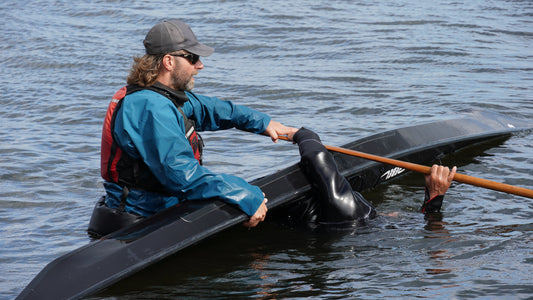

Learning a reliable kayak roll is one of the most valuable skills a paddler can develop. A dependable roll allows you to recover quickly after a capsize, conserve energy, and paddle with greater confidence in a wide range of conditions.
Many paddlers struggle to learn how to roll a kayak because they focus on the paddle instead of the body mechanics that actually make the roll work. When the physics and movement patterns are understood, the kayak roll becomes far more approachable and far more reliable.
This article explains why the kayak roll matters, why many paddlers struggle to learn it, and what a good kayak rolling course should include.
Why Rolling Is Important
Many kayakers do not see the need to learn to roll a kayak and prefer to rely on a strong brace or a rescue. While those skills are valuable, learning a reliable sea kayak roll dramatically expands both your ability and your progression as a paddler.
Instead of wearing yourself out performing repeated rescues, a reliable kayak roll allows you to recover quickly and conserve a great deal of energy. This becomes especially valuable during longer paddles or in challenging conditions where fatigue can build quickly.
Rolling becomes even more important when paddling in larger conditions or environments that push the edge of your comfort zone. In those situations, the ability to recover immediately without exiting your kayak can make a significant difference in both safety and confidence.
Is Rolling Required to Be a Kayaker?
Rolling is not required to enjoy kayaking. Many paddlers spend years on the water without ever learning a kayak roll.
However, as paddlers begin to venture farther offshore or paddle in more dynamic coastal environments, the value of a reliable roll becomes clear. The ability to recover from a capsize without exiting the kayak can greatly increase both safety and confidence.
For paddlers who want to explore bigger conditions, surf zones, or open coastal water, learning to roll a kayak is a skill well worth developing sooner rather than later.
Why Many Paddlers Struggle to Learn the Kayak Roll
Many paddlers who struggle to learn the kayak roll have difficulty separating the movement of the lower body from the upper body.
It is very natural to try to pull yourself upright using the arms and shoulders, but an efficient kayak rolling technique is driven primarily by the lower body. The upper body follows the movement rather than creating it.
When paddlers rely on their arms, the roll becomes forced and inefficient. The real power of the kayak roll comes from the continual rotated pressure from the hips and lower body (thighs), which initiate the movement.
Once a paddler connects these pieces and allows the body to work together, the struggle often begins to disappear. The movement becomes smoother, more relaxed, and what once felt difficult begins to feel almost like a dance.
Greenland Paddle vs Euro Paddle Rolling
There is very little difference between rolling with a Greenland paddle and rolling with a Euro paddle when the kayak roll is performed correctly.
When paddlers learn an efficient rolling technique, they quickly realize that the paddle itself plays a much smaller role than expected. The paddle provides support and direction, but it is the movement of the hips and body that actually brings the kayak upright.
This is why experienced paddlers can perform a Greenland roll without a paddle, with objects in their hands, or during traditional rolling competitions where many variations are performed.
At that level, rolling becomes less about the paddle and more about understanding the physics and body mechanics behind the movement.
What a Good Kayak Rolling Course Should Include
A good kayak rolling course should provide clear direction and answer the question why. Understanding why a movement works is just as important as knowing what to do.
When learning how to roll a kayak, it is far more effective to understand the underlying physics and body mechanics before entering the water. When the movement is understood clearly, the mind can break the roll down into smaller and more manageable pieces.
This approach makes learning the kayak roll far less confusing and far more efficient. Instead of repeating movements without understanding them, paddlers begin to see how each part of the roll connects and supports the next.
A well designed kayak rolling course builds this foundation first. Paddlers enter the water with a clear mental picture of the movement they are trying to achieve, making it much easier to refine technique and develop a consistent and reliable roll.
Continue Developing Your Kayak Roll
Learning a reliable kayak roll takes time, practice, and a clear understanding of the body mechanics behind the movement.
If you would like to refine your technique or work toward a more consistent roll, small group instruction can make a significant difference.
You can explore upcoming rolling camps and workshops here: