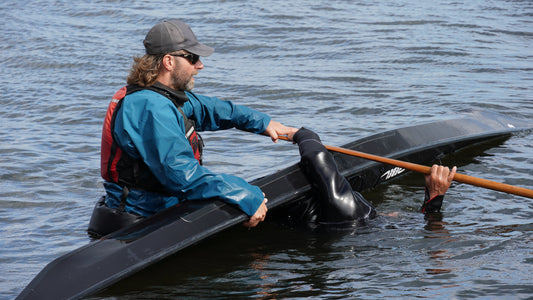

There is something magical about a roll.
It is not just a skill. It is not just a recovery. It is a moment where you and your kayak reconnect with the water. When it clicks, it feels effortless. Quiet. Almost graceful. When it does not, it can feel like you are fighting the ocean.
After years of teaching paddlers around the world, I continue to see the same three hidden mistakes surface again and again. They are often subtle. They are not solved by getting stronger. They are solved by becoming more connected, more precise, and more aware.
Let’s capsize into it.
#1 Upper Body Driven Instead of Lower Body Led
Most paddlers try to fix their roll by pulling harder with their arms and shoulders.
Your brain says pull.
Your body says lift your head.
And suddenly the roll becomes a strain instead of a rhythm.
The issue is not strength. The issue is direction.
The upper body should be relaxed and responsive. It follows. It does not lead. Your lower body, your hips and thigh rotation, that is the engine of the roll.
When the hips rotate properly, the kayak responds instantly. When the hips hesitate, the shoulders jump in to compensate. That is when people start feeling it in their arms or loading their shoulder.
If you feel like you are doing a pull up to get upright, take a step back.
When the mechanics are correct, the kayak comes up first. Your body simply settles back on top of it. Calm. Controlled. Almost lazy.
Rolling is not about force. It is about alignment and connection.
#2 Timing Is Backwards
This one is huge.
You set up. You sweep. You begin to rise. Then you engage your hips and legs. Too often, paddlers release their leg drive and rely on the paddle instead.
Then everything feels unstable and your brain tells you to sit up fast.
That instinct is backwards.
Once your body is in position and you have created your platform, your focus should shift to getting the kayak off you first with your hips and thighs. Maintain that driven position all the way through the recovery without releasing it. Let the kayak rotate upright underneath you.
Only after the kayak is nearly upright should your upper body follow. The paddle is simply an extension of your upper body, so it should not lead the movement. If you reverse the order and allow the hips and thighs to initiate with proper timing, the roll feels almost effortless.
Many people blame the head, and while that is part of it, the real issue is what the head triggers. When you lift your head early, you naturally lift your opposite leg. That leg lift is what capsizes the kayak back on top of you. That thigh should not be lifting. It should be driving downward in rotation with your hips.
When the kayak rises first, the head and torso follow naturally. There is no rush.
It feels counterintuitive at first. You have to override that survival reflex. But once you trust the sequence, the roll becomes smoother, lighter, and far more reliable in rough water.
#3 No Flow
When we learn something new, we break it into steps.
That is useful in the beginning.
But a great roll is not robotic. It is fluent. It flows. It uses buoyancy, rotation, and momentum together in one continuous arc.
When the movements are disconnected, the roll feels clunky. You pause. You hesitate. You force each phase.
When it flows, there are no hard stops between movements. The sweep blends into rotation. The rotation blends into recovery. The kayak and body move as one seamless motion.
Think of Tai Chi. Energy is created through continuity, not tension.
That kind of efficiency, without overthinking, is what makes a roll dependable when the water is moving and the stakes are higher.
The Bigger Picture
When you truly connect with the mechanics, something shifts inside you. Struggle turns into trust. Effort turns into rhythm. You stop chasing steps and start feeling the movement.
Suddenly you are not fighting.
You are dancing.
You are allowing the kayak to rise instead of commanding it.
If you are working on your roll right now, slow it down. Feel your lower body. Trust the timing. Blend everything into one smooth motion.
That is where the real therapy of kayak rolling begins.
Stay Salty, my friends.