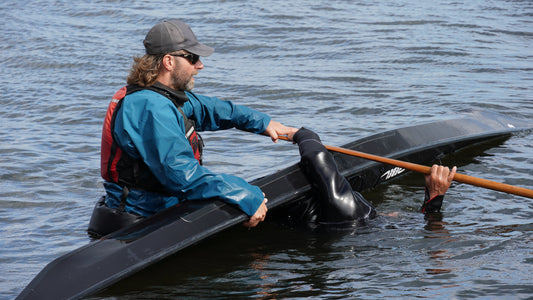

When people think about kayak rolling, they usually see it as a skill to master, something technical that needs to be refined and practiced until it becomes consistent. Can you roll every time, can you do more advanced variations, can you make it look clean. That is often where the conversation starts and for some people, that is where it stays.
But over the years, both through my own experience and through teaching, I have come to see that rolling is much more than just a skill. It becomes a reflection of how you approach challenge, pressure, and growth, and whether people realize it or not, they tend to move toward one of two paths. A competitive journey or a personal one.
There are people who are naturally driven by competition, and this can be a very powerful force. It gives direction, it creates motivation, and it pushes people to levels they may not reach otherwise. These are the people who want to stand out, who want to be the best in the group, and who feel a strong sense of purpose in proving to themselves and to others what they are capable of. There is absolutely nothing wrong with that, and in many cases, competition can accelerate growth in a way that nothing else can.
At the same time, there is another side to it that is not always talked about. When the focus shifts too far toward performance and recognition, pressure begins to build. Instead of simply learning and exploring the movement, the mind starts to ask different questions. Am I good enough, do I look good doing this, what are others thinking about my performance. That pressure can slowly turn into anxiety, and once that happens, rolling can begin to feel forced rather than fluid.
I see this quite often, especially with students who are hard on themselves. They are capable, they are putting in the effort, but they are carrying a weight that does not need to be there. When a roll does not come up, it is no longer just part of the learning process, it starts to feel like failure, and that can be difficult to manage mentally. What was once an opportunity to grow becomes something that creates stress.
A big part of this comes down to how rolling is taught in the first place. Most instruction is built around mechanics. Step by step movements, positions, angles, timing, all broken down into pieces that need to be executed correctly. Mechanics are important, there is no question about that, but when they become the primary focus, they often feed into that competitive mindset. People begin to measure themselves based on how well they can replicate a movement, how clean it looks, and how consistent it is compared to others.
It becomes performance.
And performance naturally invites comparison.
On the other side, there is the personal journey, and this is where rolling becomes something much deeper. There is no need to prove anything to anyone, and the focus shifts inward rather than outward. Instead of chasing perfection or recognition, the experience becomes about understanding. Understanding how your body moves, how your breath affects your movement, and how your mind responds when you are upside down in the water.
This is where methodology comes in, and this is the foundation of how I teach.
Methodology is not about memorizing steps, it is about understanding principles. It is about building awareness first, then allowing the movement to come from that awareness. Instead of telling someone exactly what to do at every moment, it is about guiding them to feel what is happening and why it works.
When someone begins to understand the why behind the movement, everything changes. They are no longer trying to force a result, they are allowing the roll to happen through timing, connection, and awareness.
I have watched this transformation happen many times. Students come in tense, trying to control every part of the movement, overthinking each step and bracing themselves for failure. But as they begin to shift away from mechanics as the only focus and start to understand the methodology behind it, something changes. Their movement becomes smoother, their breathing slows down, and they start to trust the process rather than fight it.
That is usually the moment where everything starts to click.
For many people, rolling becomes a form of therapy. It creates space to focus, to reset, and to reconnect with themselves in a way that is hard to find elsewhere. There is no audience, no expectation, just the experience of being in the water and working through something that is both physical and mental at the same time. In that space, people often learn more about themselves than they expected.
Now we bring social media into the picture, and this is where things can get a bit complicated. We live in a time where everything can be shared, every session, every success, every clean roll, and while that can be inspiring, it can also quietly shift our intention. Humans naturally want validation, we want to feel seen, accepted, and recognized, and social media amplifies that in a way that can be hard to ignore.
The challenge is that it can start to distort reality. What people see online is often a highlight reel, the best moments, the cleanest rolls, the successes without the struggle that came before them. Over time, this creates a subtle comparison that can pull people away from their own experience. The focus begins to shift from how something feels to how it looks, from being present in the moment to performing for an audience.
This is where it can become addictive, and not in a healthy way. The need for attention and validation can slowly take over, and without realizing it, people can lose the connection to why they started in the first place.
For me personally, rolling was never about competition. I came into kayaking during a time when I was looking for something completely different. I needed clarity, I needed space, and I needed a way to reconnect with myself. Rolling became that for me. It forced me to slow down, to become aware of how my body moved, and to understand how my mind reacted under pressure. It taught me that forcing things rarely works and that awareness and timing are far more powerful than effort alone.
That experience is the reason I focus so heavily on methodology over mechanics in my teaching. Mechanics will get you a roll, but methodology will allow you to understand it, adapt it, and truly own it. Mechanics can be copied, but methodology is something you develop within yourself.
At the end of the day, this is not about saying one path is right and the other is wrong. Competition can be a powerful tool and for some people it is exactly what they need. But it is worth asking yourself why you are doing this in the first place. Are you chasing recognition or are you exploring something deeper. Are you trying to prove something or are you trying to understand something.
Because rolling will give you both options.
One path will constantly push you outward, toward performance, comparison, and recognition. The other will bring you inward, toward awareness, connection, and personal growth. In my experience, it is that second path where the real transformation happens, and where rolling becomes more than just a skill.
It becomes a way of understanding yourself, and that is something far more valuable than any perfect roll.